Renovation Guide · 6 min read
A Realistic Renovation Timeline, Week by Week
From demo to final walkthrough — what actually happens each week of a full renovation, and where the delays tend to creep in.
By Seán Kirwan · Founder, Kirwan Carpentry · Dec 2025
On this page
Every homeowner wants to know the same two things: how much, and how long. We cover the money in our cost breakdown; this guide is about time. Here’s what actually happens, week by week, on a typical mid-size Toronto renovation — and why the parts you can’t see often take the longest.
Before week one: design, drawings and permits
The single biggest cause of a delayed start isn’t the building — it’s the paperwork before it. Design, engineering and permits and drawings can take anywhere from a few weeks to a few months depending on scope and the city’s queue. Structural changes and additions need engineered drawings and a building permit; a straightforward kitchen or bathroom in the same footprint may need very little. We start this clock as early as possible, because everything downstream waits on it.
This is also when cabinets and long-lead items get ordered. Custom cabinetry and windows can carry six-to-ten-week lead times, so ordering during the permit wait keeps them off the critical path.
Weeks 1–2: demolition and discovery
Once permits are in hand, demolition is fast and satisfying — a room can be stripped to studs in a day or two. It’s also when the house tells you its secrets. Opening walls in an older home routinely reveals wiring, plumbing or framing that has to be dealt with before anything new goes in. On a full home renovation we build this discovery window into the schedule deliberately, because pretending it won’t happen is how projects fall behind.
Weeks 2–4: structure, framing and rough-ins
This is the heavy phase. Any structural openings — removing a wall, installing a beam — happen now, followed by new framing for the new layout. Then the rough-ins: electrical, plumbing and HVAC run through the open walls. It’s the least glamorous stage and often the longest, because everything that gets buried has to be right before it’s covered. Inspections happen at the end of this phase and have to pass before insulation and drywall.
Weeks 4–6: insulation, drywall and a quiet stretch
Once rough-in inspections pass, walls close up. Insulation, then drywall — hung, taped, mudded and sanded over several days with drying time between coats. This is the stretch where it can feel like nothing is happening, but the drying and sanding can’t be rushed without it showing in the final paint. By the end of it the rooms have their shape back.
Weeks 6–9: the finish carpentry that makes it
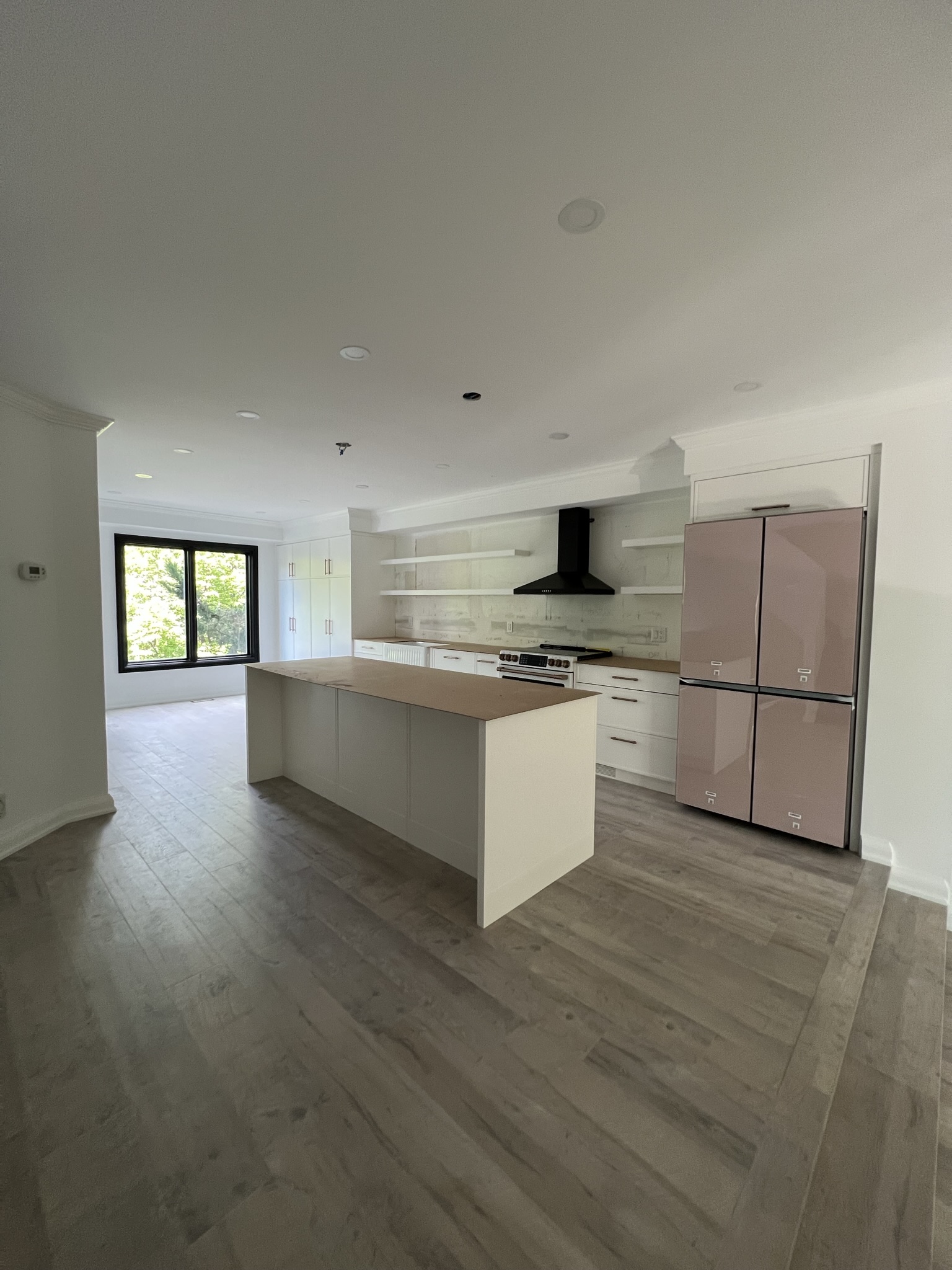
Now the house starts to look like yours. Flooring goes down, then the work that defines the quality of the whole job: finished carpentry — doors, baseboards, casings, trim and moulding, and any built-ins. Cabinets are set and scribed, counters templated and installed, tile laid, stairs and railings fitted. This is slow, exacting work and it’s where a trained joiner earns their keep — the difference between a renovation and a finished home is measured in millimetres here.
You can rush demolition. You cannot rush finish carpentry. The last ten percent of a renovation is half the reason you’ll love it or live with regrets.
Weeks 9–10: paint, fixtures and the punch list
Final paint, light fixtures, plumbing fixtures, hardware and the deep clean. Then the walkthrough, where we build a punch list together — the small snags every project has — and close them out. Only then is it done. A good builder doesn’t disappear at 95 percent; the punch list is part of the job, not an afterthought.
So how long, really?
A single kitchen or bathroom in the same footprint: four to eight weeks of on-site work. A multi-room or whole-floor renovation: ten to sixteen weeks. A full home renovation or an addition: four to eight months. Add the design-and-permit runway on the front of all of them. The honest version is that the building rarely runs late once it starts — it’s the front-end and the mid-project surprises that move dates, and both are managed with planning rather than optimism. If you want a realistic schedule for your specific house, reach out and we’ll map it out.

Seán Kirwan
Dublin-trained carpenter and joiner, founder of Kirwan Carpentry. He’s been on the tools since 2010 and has renovated homes across Toronto and Ontario.
Renovation Guide · 9 min read
How Much Does a Kitchen Renovation Cost in Toronto? (2026)
Have a project you’d love to bring to life?
Tell us a little about your home and what you’re dreaming up. We’ll get back to you within one business day to talk it through — no pressure, no obligation.